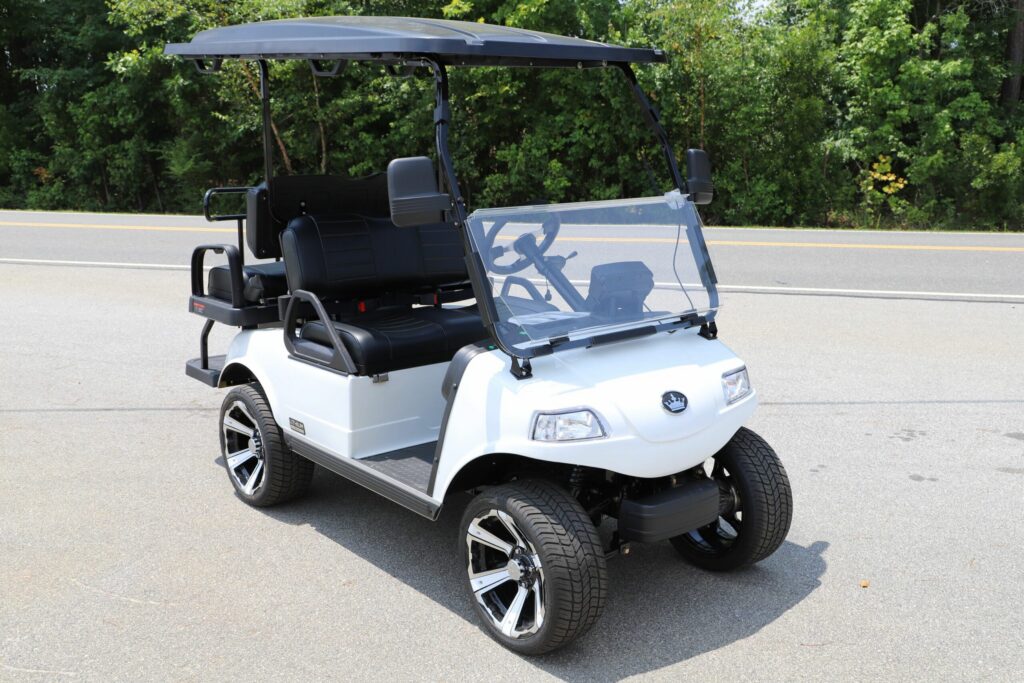
When shopping for an electric golf cart, you may come across models described as 36-volt or 48-volt.
The difference sounds simple, but voltage can affect acceleration, power delivery, hill performance, battery configuration, charging, and efficiency.
Throughout North Carolina, golf carts are commonly used for neighborhood transportation, recreational properties, golf courses, farms, and community driving. Choosing the right electrical system depends on how and where you plan to use your cart.
A 36V golf cart can still be a practical option for lighter use, especially on flatter terrain. Many newer electric carts, however, use 48V or higher-voltage systems designed to provide stronger everyday performance.
This guide explains the main differences between 36V and 48V golf carts and what buyers should consider when comparing them.
What Does 36V or 48V Mean on a Golf Cart?
The voltage rating describes the nominal voltage of the golf cart’s main battery system.
In a traditional lead-acid cart, multiple batteries are connected in series to create the required system voltage.
A traditional 36V golf cart commonly uses:
- Six 6-volt batteries
A traditional 48V golf cart may use:
- Six 8-volt batteries
- Eight 6-volt batteries
- Four 12-volt batteries
Modern lithium carts may instead use a single lithium battery pack designed for the cart’s voltage class.
The exact setup varies by manufacturer, model, year, and battery type.
Voltage should also not be confused with battery capacity. Two carts can both be 48V while having very different battery capacities, motors, controllers, and driving ranges.
Does a 48V Golf Cart Have More Power?
A higher-voltage electrical system can provide advantages when delivering power to the drivetrain.
For the same amount of electrical power, a 48V system can generally operate at a lower current than a 36V system. Lower current can help reduce electrical losses and heat through cables, connectors, controllers, and other components.
In everyday driving, many 48V carts provide stronger acceleration and better performance under load than older 36V designs.
Actual performance also depends on:
- Motor
- Controller
- Battery condition
- Battery capacity
- Gear ratio
- Tire size
- Cart weight
- Passenger load
- Terrain
A poorly maintained 48V cart with weak batteries may perform worse than a properly maintained 36V cart.
Customers comparing current electric models can browse J’s Golf Carts’ new golf cart inventory to explore different configurations and features.
Is a 48V Golf Cart Faster Than a 36V Golf Cart?
Not necessarily.
A 48V system may offer more performance potential, but voltage by itself does not determine top speed.
Top speed can also be affected by:
- Motor design
- Controller programming
- Gear ratio
- Tire diameter
- Vehicle weight
- Speed settings
- Battery condition
A manufacturer may electronically limit the speed of a 48V cart, while a modified 36V cart could travel faster depending on its setup.
Where drivers may notice the difference more clearly is acceleration and performance under load. A 48V cart may feel more responsive when carrying several passengers or traveling through changing terrain.
Owners interested in learning more can read our guide on how fast golf carts can go.
36V vs. 48V Golf Carts on Hills
Hills can make differences between electrical systems more noticeable.
Climbing an incline requires more power than driving across flat pavement, especially when carrying several passengers.
In comparable systems, a higher-voltage design can provide the needed power while drawing less current, which can help support performance under heavier loads.
Poor hill performance can also be caused by:
- Weak batteries
- Low tire pressure
- Oversized tires
- Excessive passenger or cargo weight
- Worn electrical connections
- Motor or controller issues
- Dragging brakes
A healthy 36V cart may still perform well on relatively flat terrain with lighter loads.
Drivers who regularly travel through hilly neighborhoods or carry several passengers may prefer the stronger performance available from many newer 48V systems.
Our guide explaining why golf carts lose power going uphill covers additional causes of poor hill performance.
Does a 48V Golf Cart Have More Range?
Not automatically.
Voltage alone does not determine how far a golf cart can travel on one charge.
Range depends on usable battery energy and the efficiency of the vehicle.
Important factors include:
- Battery capacity
- Battery chemistry
- Battery age
- Driving speed
- Terrain
- Passenger weight
- Tire pressure
- Tire size
- Temperature
A 48V system may operate efficiently, but a 36V cart with a larger or healthier battery pack could still travel farther than a 48V cart with a smaller or worn battery pack.
When comparing carts, buyers should look at complete battery specifications and manufacturer range information rather than assuming higher voltage always means longer range.
Battery Maintenance and Charging
Whether your cart operates on 36V or 48V, battery condition plays a major role in performance.
Weak or poorly maintained batteries can cause:
- Slow acceleration
- Reduced range
- Poor hill performance
- Longer charging times
- Difficulty reaching a full charge
Traditional flooded lead-acid batteries require routine attention to water levels, terminals, cables, and charging habits.
Lithium systems generally require less routine maintenance, but owners still need to use the correct charger and follow the battery manufacturer’s charging and storage instructions.
The charger must match the voltage and battery chemistry of the golf cart. A charger designed for a 36V system should not be used on a 48V system.
Owners can learn more in our Golf Cart Battery Maintenance Guide.
How Can You Tell if a Golf Cart Is 36V or 48V?
If you are shopping for a used cart, verify the voltage before purchasing.
Start by checking:
- Manufacturer information
- Model and serial number
- Battery labels
- Charger label
- Owner’s manual
- Vehicle data plate when available
On a traditional lead-acid cart, you may also be able to determine the system voltage by checking each battery and counting how many are connected in series.
For example:
- Six 6V batteries typically create a 36V pack
- Six 8V batteries typically create a 48V pack
Golf carts can be modified, and lithium systems may use different configurations, so it is best to verify the actual setup when there is any uncertainty.
Buyers comparing pre-owned carts can browse J’s Golf Carts’ used golf cart inventory to explore available models and configurations.
Is a 36V Golf Cart Still Worth Buying?
A 36V cart should not automatically be ruled out because it uses an older voltage standard.
A well-maintained 36V cart may still make sense for:
- Golf course use
- Private property
- Short recreational trips
- Flat terrain
- Light passenger loads
- Buyers looking for a lower-cost used cart
Condition is often more important than voltage when evaluating an older golf cart.
Before purchasing, inspect the batteries, charger, wiring, brakes, tires, steering, suspension, frame, and maintenance history.
An inexpensive 36V cart that immediately needs batteries and multiple repairs may not provide the value it first appears to offer. A clean and properly maintained cart may be a much better buy.
Can You Convert a 36V Golf Cart to 48V?
It may be possible to convert some 36V carts to 48V, but the process is not as simple as installing higher-voltage batteries.
A conversion may require changes to:
- Battery pack
- Charger
- Controller
- Solenoid
- Motor
- Wiring
- Other voltage-sensitive components
Using components at a voltage they were not designed to handle can cause damage or create safety concerns.
Owners considering a conversion should compare the cost of upgrading the existing cart with the cost of purchasing a newer cart already designed around a 48V system.
J’s Golf Carts offers professional golf cart service and repair for customers who need inspections, electrical troubleshooting, maintenance, or help evaluating their current cart.
36V vs. 48V Golf Cart: Which Should You Choose?
There is no single answer that is right for every driver.
A 36V golf cart may make sense if:
- You already own a well-maintained 36V cart
- Most driving is on flat terrain
- Trips are short
- Passenger loads are light
- You are shopping for an affordable used cart
A 48V golf cart may make more sense if:
- You are purchasing a newer electric cart
- You regularly carry multiple passengers
- Your driving area includes hills
- You want stronger acceleration
- You use larger tires or accessories
- You expect frequent neighborhood use
Voltage matters, but it is only one part of choosing the right golf cart.
Final Thoughts on 36V vs. 48V Golf Carts
Both 36V and 48V golf carts can provide dependable transportation when properly maintained and used for the right purpose.
A 48V system can offer advantages in power delivery, acceleration, efficiency, and performance under load, while a healthy 36V cart may still be perfectly suitable for shorter trips, flatter terrain, and lighter recreational use.
Battery capacity, battery condition, motor, controller, tires, weight, terrain, and driving habits all influence how an electric golf cart actually performs.
Before purchasing, consider where you plan to drive, how many passengers you carry, how far you travel, and what level of performance you expect.
At J’s Golf Carts, our team helps customers compare new and used models, battery systems, features, and configurations to find a golf cart that fits their needs.
Whether you are shopping for your first electric golf cart, comparing 36V and 48V options, or need service for your current cart, our team is here to help every step of the way.