
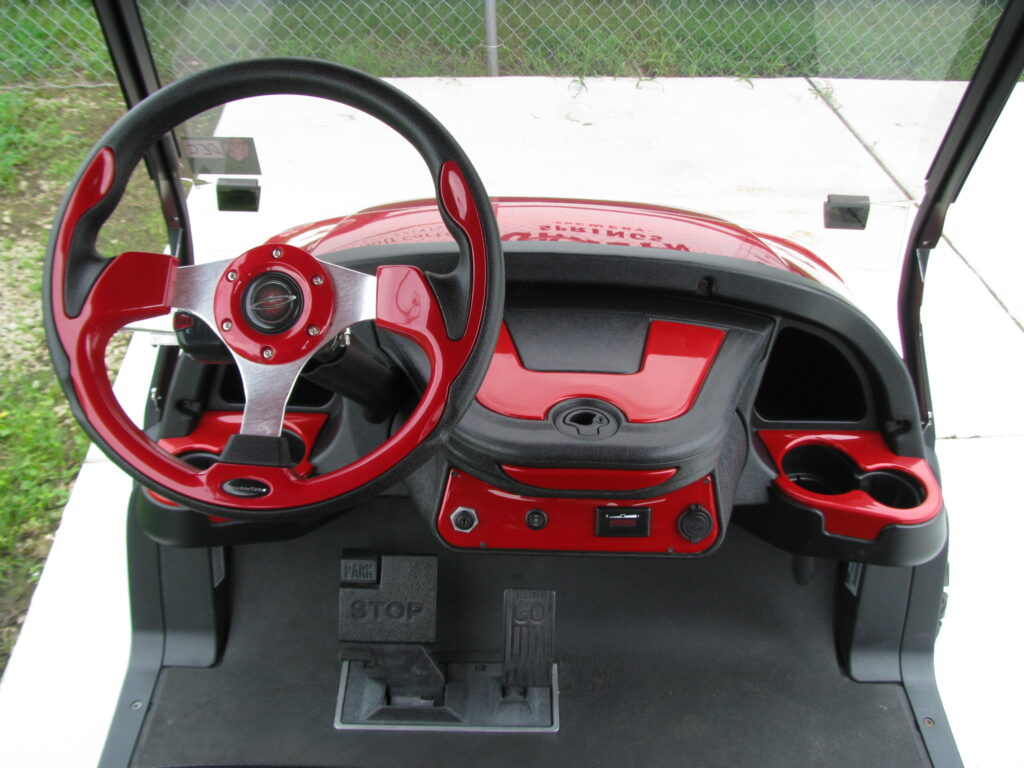
Your golf cart should accelerate smoothly when you press the pedal. But what if it suddenly jerks forward, hesitates before moving, or repeatedly surges as you pick up speed?
It might happen when you first take off, climb hills, or carry passengers. Jerky acceleration can point to inconsistent electrical signals, interrupted power delivery, or engine and drivetrain problems. For North Carolina owners using carts for neighborhood transportation or daily driving, unexpected surging can also become a safety concern.
The good news is that jerking does not automatically mean your golf cart needs a new motor or controller. Several different problems can create similar symptoms, so identifying the pattern is an important first step.
Here are five common causes and what owners should know before scheduling repairs.
#1 Weak or Failing Golf Cart Batteries
For electric golf carts, batteries are one of the first systems to consider when acceleration becomes inconsistent.
Your cart’s batteries may have enough charge to power the dashboard and move the vehicle at low demand, but still struggle when the motor needs more current to accelerate or climb a hill.
Aging batteries can develop excessive voltage drop under load, causing hesitation or power loss. On some lithium-equipped models, the battery management system may limit or interrupt output to protect the pack.
Possible signs include:
- Jerking or hesitation when accelerating from a stop
- Noticeably weaker performance on hills
- Reduced driving range between charges
- Acceleration that gets worse as the batteries discharge
- Unusual battery or charging warnings
- A cart that feels stronger immediately after charging
One weak battery can affect an entire multi-battery pack, but jerking alone does not prove battery failure. A technician may need to test the pack under load. Owners can also review our Golf Cart Battery Maintenance Guide for ways to support battery health.
#2 Loose or Corroded Electrical Connections
Sometimes the batteries are working properly, but the connections carrying power to the drive system are not.
Vibration and moisture can loosen or corrode connections over time. This may create resistance or intermittent power delivery, especially during acceleration, resulting in hesitation or repeated surges.
Warning signs can include:
- Jerking that appears unexpectedly rather than at one specific pedal position
- Intermittent power loss, especially over bumps
- Corrosion around battery terminals
- Frayed, cracked, or discolored cables
- Melted connectors or a burning smell
- A cart that sometimes drives normally and sometimes hesitates
Corrosion is common around neglected flooded lead-acid battery terminals, but lithium-powered carts can also develop connection problems.
You can visually check for obvious damage with the cart turned off and the charger disconnected. Do not touch damaged cables, tighten high-current terminals, or test energized connections without proper training. Golf cart battery packs can deliver dangerous electrical current.
A qualified technician can inspect connections and perform appropriate voltage-drop testing before recommending replacement parts.
#3 A Worn Accelerator Pedal or Throttle Sensor
This is one cause golf cart owners may not immediately consider.
On many electric golf carts, pressing the accelerator sends an electronic signal to the motor controller. The controller uses that signal to determine how much power to deliver to the motor.
Different models use different sensors. Certain Club Car models, for example, use a Motor Controller Output Regulator (MCOR).
If a sensor develops worn spots, sends an inconsistent signal, or has a wiring problem, the controller may receive an uneven command instead of a smooth increase in requested acceleration.
Possible symptoms include:
- A sudden jump when you first press the accelerator
- Hesitation followed by an unexpected surge
- Jerking at roughly the same pedal position
- Inconsistent response as you gradually press the pedal
- A pedal that feels sticky, loose, or otherwise unusual
Jerking at the same pedal position can suggest a throttle input problem, although damaged wiring may cause similar symptoms. Sensor testing should use the correct specifications for the cart.
Avoid trying to bypass a pedal switch or throttle sensor. These components can be part of the vehicle’s safety and drive-control systems.
#4 Solenoid, Controller, or Motor Control Problems
Electric golf carts rely on additional components to manage how power reaches the motor.
A solenoid or contactor acts as an electrical switch on many models, while the controller regulates motor operation.
If a solenoid has worn contacts, loses its control signal, or repeatedly engages and disengages, the cart may hesitate or lose drive power. Controller-related faults can create similar behavior, although a controller should never be blamed without testing the other systems first.
Watch for signs such as:
- Repeated clicking that occurs alongside the jerking
- Sudden changes in acceleration
- Intermittent loss of drive power
- Fault codes or warning lights
- Performance that changes as components warm up
- A cart that sometimes refuses to move at all
A single click can be normal. Repeated clicking with power loss is more concerning. The controller could also be responding to weak batteries or a faulty input, so replacing it without diagnosis may not solve the problem.
Learn more in our guide explaining how to tell if a golf cart solenoid is bad.
#5 Gas Golf Cart Clutch, Belt, or Engine Performance Problems
Gas-powered golf carts can jerk during acceleration too, but the likely causes are often different from those found on electric models.
Many gas carts use a drive belt and clutches to transfer engine power to the wheels.
A worn or damaged drive belt, sticking clutch, or other drivetrain problem can cause uneven engagement, a shudder when taking off, or an abrupt change in how the cart moves.
Gas engine problems can also feel like jerking. If the engine stumbles when you press the accelerator, possible areas to inspect include:
- Dirty or restricted air filters
- Fuel delivery problems
- Worn spark plugs or ignition problems
- Carburetor issues on equipped models
- Throttle linkage or adjustment problems
- Worn drive belts or clutch components
If the engine sputters as the cart jerks, an engine problem may be involved. If the engine runs smoothly but the cart shudders at takeoff, suspect the clutch or drivetrain.
Avoid reaching near moving belts or clutches while the engine is running. Those components should be inspected and serviced using the manufacturer’s procedures.
Is Your Golf Cart Jerking or Just Riding Rough?
Not every shake or vibration is an acceleration problem.
Steady-speed vibration may point to tires, wheels, bearings, or suspension. Shuddering mainly while braking could indicate brake problems, while dragging brakes can make acceleration feel sluggish.
Ask yourself whether the movement happens specifically when you press the accelerator or whether it continues while maintaining speed.
If the ride feels rough even without changes in throttle, our guide on how to make a golf cart ride smoother discusses other areas worth inspecting.
What Does the Timing of the Jerking Tell You?
The circumstances surrounding the problem can help a technician narrow down the possibilities.
Jerks when first taking off: Consider accelerator inputs, electrical connections, or clutch engagement on gas carts.
Jerks mainly on hills: Increased load may reveal weak batteries, voltage loss, or an engine or drivetrain problem.
Jerks after driving for a while: Note whether the symptoms appear after the cart warms up or the charge level drops. Electrical and mechanical issues can both change with temperature or load.
Jerks over bumps: Vibration-related connection problems are one possibility, although suspension or drivetrain movement can produce similar sensations.
Jerks at the same pedal position: An accelerator sensor or pedal mechanism could be involved.
These clues can guide diagnosis without proving any single cause.
What Should You Check Before Scheduling Repairs?
If your golf cart begins surging or lurching unpredictably, stop using it for normal transportation until the cause is identified. Sudden changes in acceleration can be dangerous around pedestrians, vehicles, and hills.
Once it is safely parked on level ground, you can make a few basic observations:
- Check the battery indicator. For an electric cart, note the charge level and whether any warnings appear.
- Think about when the problem started. Was it sudden, gradual, or shortly after a repair or modification?
- Look for visible damage. With the cart off, inspect accessible areas for corrosion, damaged cables, leaks, or obvious tire problems without handling electrical components.
- Listen for unusual sounds. Clicking, grinding, engine sputtering, or belt noises may help identify which system needs attention.
- Record the symptoms. Note whether the cart jerks at takeoff, on hills, after warming up, or at a particular pedal position.
Avoid repeated driving tests, bypassing safety switches, or guessing at replacement parts.
When Should You Have a Jerking Golf Cart Serviced?
Jerky acceleration should be inspected when it continues, becomes more frequent, or makes the cart difficult to control.
Seek professional help for sudden surging, power loss, burning smells, overheating, unusual noises, or fault warnings.
J’s Golf Carts provides golf cart service and repair for customers needing battery and cable maintenance, inspections, troubleshooting, and other repair work. The team also offers golf cart parts and accessories for a variety of models.
If transporting the cart is difficult, J’s offers golf cart pickup and delivery for service, with an additional fee. Contact the shop to discuss availability.
Final Thoughts on a Golf Cart That Jerks When Accelerating
A golf cart that jerks, bucks, or hesitates when accelerating is telling you something is not operating as smoothly as it should.
For electric models, weak batteries, poor connections, worn accelerator sensors, and motor-control problems are all possibilities. For gas models, clutch, belt, fuel, or ignition problems may be responsible.
Identify the cause before replacing expensive components.
At J’s Golf Carts, our team helps customers throughout Holly Springs, Fuquay-Varina, Raleigh, Cary, Apex, and surrounding North Carolina communities maintain and repair their carts.
Whether you need battery testing, electrical troubleshooting, drivetrain service, or a preventative inspection, we’re here to help your golf cart get back to smooth, reliable performance.